Showing posts with label Bettina von Zwehl. Show all posts

Friday, 6 March 2020

WR2

Plans for Shoot

For this shoot, I will be researching into the photographer Bettina von Zwehl, who was recommended in the exam paper, I will then be recreating Zwehl's work personally, and see where this will influence my future work.

Research
Bettina von Zwehl
Bettina von Zwehl is a German photographer who lives and works in London. She is known for her "subtle and unnerving" portrait photography. Many of her portraits are either of children in formal presentations and harsh lighting, or of adults in unflattering and odd positioning and lighting. I did further analysis on Zwehl's work in the blog post "Photographer Research - Bettina von Zwehl". After research into her work, it was clear that Zwehl used harsh studio lighting and most likely a lower shutter speed to capture the slight movement captured in the models.

Image bank
These are a few photos from Zwehl's portfolio 'Alina'.

Contact sheet
These are all the photos I took for this shoot.


Best Photos
These are the best-selected photos from this shoot.


Photos that require improvement
These are a few of the photos that required improvement in my shoot, the issues with these photos was due to shutter speed settings. In Zwehl's work it appeared as though she used a slightly longer shutter speed to capture a slight motion in the photo. So, during my shoot I experimented with different shutter speeds to try and recreate this. In the brighter photos the shutter speed was roughly 1/60-80sec, however in these darker photos the shutter speed was roughly 1/4-2secs, also increasing the aperture to F11. This unfortunately removed the intensity of light in the photo and created a slight yellowish haze in the photos. This shutter speed was for too long and captured too much movement, leaving an unsettling yellow blur to the photos which does not represent Zwehl's work accurately. Once realising this I changed the shutter speed back to a faster setting to ensure the light intensity was still there and and blur was at minimal intensity.

AO3: Record ideas, observations and insights relevant to intentions, reflecting critically on work and progress.

My Ideas

My intention for this shoot was to research into the second recommended photographer Bettina von Zwehl and use this research to recreate her work and further influence my topic of artificial lighting. From my research I discovered that Zwehl used intense studio lighting settings to create a harsh and sterile light onto the models, she also candidly captured the models using a long shutter speed to capture the slight impression of movement, this helped me with recreating her work. When creating my own shoot, I was unable to recreate the exact setup to Zwehl's, so this effected the recreation accuracy. I varied my shutter speeds in my shoot to see which would best recreate the minimal blur that Zwehl creates. I do not feel I was as successful as I intended to be with this shoot, as my photos compared to Zwehl's lack something that Zwehl's has and it appears vital. 

Reference to best photos

I selected this photo because of the personal atmosphere it creates with the viewer. This photo may not be candid like Zwehl's but this still creates a perplexing and intense atmosphere to the photo. Due to me looking directly into the camera, with a rather vacant expression to my face, it makes the viewer feel as though they have intruded my personal space and I have no confronted them, creating this awkward tension between me and the viewer. My surroundings being completely white and empty makes it appear as though I am in my own world different from the viewer's, and I am curious of it in this photo, hence why I am looking out to the viewer.

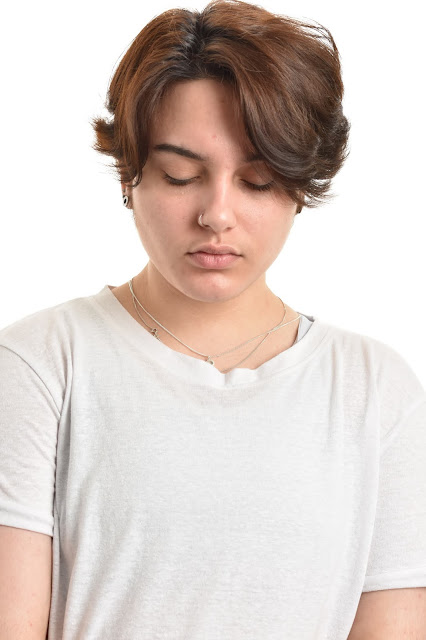
I selected this photo because I feel it is an accurate recreation of Zwehl's work. My body posture appears stiff and rigid, as though something is making me uncomfortable while this photo is being taken. Due to my face looking down and appearing deep in thought but slightly uncomfortable could suggest that my discomfort is coming from something I am thinking about, a bad memory perhaps. My entire presentation conveys a hostility, as if the viewer shouldn't be viewing this photo and is intruding on something serious and personal. The completely clear white background could make it appear as though I am so deep in thought that the world around me has disappeared, and I have been left to my own mind.

I selected this photo because of the curious atmosphere it creates. My body expression appears slightly more relaxed in this photo, but my facial expression coveys curiosity. The direction of my eyes suggest I am possibly enclosed in my thoughts, but it could also suggest there is something I am seeing that the viewer cannot see, this can create curiosity for the viewer. My facial expression could create an unsettling feeling for the viewer because they are unable to understand what I am feeling or doing.

AO2: Explore and select appropriate resources, media, materials, techniques and processes, reviewing and refining ideas as work develops.

Shoot Process/Use of Camera

For this shoot, I used the college studio and studio equipment to create my photos. Using a white backdrop behind me and pointing two dish lights to it to make sure during photos the background is a strong clear white. Then using a softbox to the left of me to flash a harsh white light, and a reflector to the right of me to then bounce that softbox light back onto the right side of me also. Using a clicker connected to the camera to make sure all equipment flashes at the appropriate time when the photo is taken, and using self-timer and a tripod to take the photos of myself. I used my Nikon D3400 camera and the settings were shutter speed varying from 1/4-1/80, and aperture dominantly set at F8, and exposure set to ISO200. I was unable to completely recreate Zwehl's work and hadn't involved a table or sitting in my shoot, so instead I would pose in front of the camera and attempt to move slightly just before the camera took a picture so I could recreate that slight impression of motion in Zwehl's photos and recreate the impression of me being candid during the photos being taken.


Experimenting

For the photos, I feel the actual subject (me) was over exposed, but to change this with the camera involved changing the exposure to the background also. So, using 'camera raw', I was able to slightly alter the exposure and saturation to photos and make them appear more defined on the subject (me).
Overall, I feel this slight editing helped the photos appear sharper and give more of an impact, so this edit was useful.

AO1: Develop ideas through sustained and focused investigations informed by contextual and other sources, demonstrating analytical and critical understanding.

Through my research, I have learned new studio techniques in creating a surreal and sterile lighting setting using studio equipment. I was also able to practice and almost perfect my technique in shutter speed to create a minimal motion blur in my photos. Zwehl helped me to better learn studio techniques and also understand better symbolism and connotations for possible photos.

AO4: Present a personal and meaningful response that realises intentions and, where appropriate, makes connections between visual and other elements. 


Progression

Overall, I feel Zwehl's work is representing a distorted empowerment to women by presenting their vulnerability in a harsh and strident way. She presents them in vulnerable compositions and uses bold lighting to make them appear helpless and in a clinical setting. I feel though I was not the most successful in recreating Zwehl's work, this was due to being unable to perfectly recreate the composition of her photos and unable to find a specific camera setting that recreated Zwehl's settings. The composition of these photos are impacting to the viewer, but I feel it does not meet the theme I wish to create in my personal work. So, moving forward, I would still like to further experiment with portraiture for artificial lighting, so in my next shoot I will look into portraiture incorporating artificial light in a more subtle and emotional manner.

Thursday, 5 March 2020

Photographer Research - Bettina von Zwehl

Bettina von Zwehl
Bettina von Zwehl is a German photographer who lives and works in London. She is known for her "subtle and unnerving" portrait photography. Many of her portraits are either of children in formal presentations and harsh lighting, or of adults in unflattering and odd positioning and lighting. 


Image result for alina bettina von zwehl
This photo presents the upper-half of a woman who appears to be sat at a blank white table; the background also being a plain white. Her clothing is minimalist, with only a plain white vest, revealing her arms and chest. The lighting of the photo makes her appear very pale as if she were sick, her body and facial expression suggests this photo is candid, as she appears unprepared for the photo and in her own thoughts. Zwehl has left a lot of negative space above and to the sides of the woman, this makes her appear smaller in comparison, it also presents a symbolism of loneliness and solitude, because it can suggest this woman has all this space and nothing to fill it with. Zwehl appears to have used a longer shutter speed to create a slight distortion of blur to the photo, this makes the atmosphere of the photo feel awkward, almost as if the viewer has intruded on this woman when she is by herself. Zwehl has used harsh studio lighting to wash out the pigment in the woman's skin and make everything appear sterile. She has most likely created this by using multiple softbox lights and reflectors to keep the light bouncing into the photo. The clothing on the woman reveals a lot of her skin and this seems to suggest a vulnerability to the woman, since skin can be symbolised as a very sensitive and personal thing, to present so much appears vulnerable. The woman's expression is dull and vacant, it appears as though she is so deep in thought that she is almost disconnected to her own body, and it is just left as a presentation of her. 

Image result for alina bettina von zwehl
This photo presents another woman dressed also in a plain white vest, while also surrounded by blank white. The woman is sat at a empty table and has her arms in front of her. Her expression is vacant and slightly blurred, suggesting Zwehl captured her in candid and also used a long shutter speed to capture some movement to create a distortion. The woman's body expression appears uncomfortable and forced, as if she is currently in an uncomfortable state of mine, leaving her feeling dissociated to her body and its positioning. Zwehl has left a lot of negative space around the woman, making her appear as if alone symbolically, or a possible symbolism of emptiness to this woman's life. Zwehl has used harsh studio lighting such as softboxes to wash out the colouring and life to the photo, making the setting appear clinical and strict. This woman's skin tone is darker compared to the other woman above, which lead to this photo appearing slightly warmer in atmosphere, but it is still rather harsh and distorted. Zwehl seems to want to create a harsh distortion in a subtle way so it leaves the viewer slightly unsettled and uncomfortable because they are not quite sure what is wrong with the photo and what is making the atmosphere appear perplexing. The woman's vacant expression appears to present some concentration, as if she is trying to find herself in this moment. Her hair is tucked behind her ears and shoulders, leaving a feeble presentation of her shoulders which appear delicate and make her seem vulnerable.

Image result for alina bettina von zwehl
This photo presents a woman sat at a empty white table, in front of a blank white background; she is also clothed in a plain white vest. This woman's pale complexion combined with the harsh lighting washes out the colour within the photo and leaves her almost appearing ill. The only prominent colour left is the rose red of her lips, which contrast well with her pale skin; the colour intensity in this one area makes her look further ill and also is a strong punctum to the photo. Compared to the two women before, this woman's hair is tied back, so her neck and facial structure is better revealed. This conveys fragility on the woman, because so much of her authentic self is being presented, her skin and feminine structure is being presented raw, and this creates a vulnerability for her. The woman's expression appears to have more meaning compared to the other women before, you can see her mouth is slightly parted and her eyes appear focused onto something; this woman appears to be thinking more heavily. Her body expression conveys more intention than the other women's, her shoulders appear relaxed and her arms are rested onto the table rather than slightly hovered over it. Zwehl's use of shutter speed and harsh lighting has still made the atmosphere perplexing, it seems as though these settings to a photo makes something seem unreal and synthetic, the wash out of colour and slight blur suggests imperfection and it leaves the photo slightly unsettling.

Image result for alina bettina von zwehl
This photo presents a woman sat, in front of a white background, at an empty white table, with her arms rested on top of it. She is dressed in a plain white vest and her hair appears to be put back. This woman appears smaller compared to the other women, this could be due to her having a lot more negative space surrounding her, her size makes her appear more frail. Because of the woman's complexion, the atmosphere is slightly warmer than if she was paler. Nonetheless, Zwehl's light settings create a harsh and strict atmosphere, the lighting almost feels as though a leader to this woman, it restricts and controls how she must present. The method of a candid photo in this context must create an interesting effect, because Zwehl is using intense studio lighting, taking a photo candidly may create a state of shock to the women, thus creating a distorted photo due to the possible movement of shock. This woman appears more relaxed in her situation, this is conveyed in her relaxed body expression and the ease on the woman's jaw; this may be due to her being lost in thought, since her eyes hold a distance in them that suggests she is focused on something in her mind.

Overall...

I feel Zwehl's work is extremely interesting, the subtle distortion she creates through artificial light and camera settings is exceedingly effective in creating an unsettling photo that can confuse a viewer, because it is so subtle that it it very difficult to pinpoint what is actually wrong with the photo. I feel Zwehl in this portfolio 'Alina' wanted to create something in tribute to women and their raw presentation. The use of washing out almost all possible colour and stripping these women to vests that reveal majority of their skin leaves them as their authentic, raw selves, with nothing to distract that. Zwehl's use of artificial light in portraiture is very impacting and interesting.

Zwehl, B (2004), "Alina", [http://www.bettinavonzwehl.com/alina.html#], (accessed:11/02/2020)

After Recreation...

Image result for alina bettina von zwehl 
After research into Zwehl's work, I discovered her techniques to create her photos involved intense studio lighting and slower shutter speeds to create a subtle blur to form a distorted appearance. With this information, I felt capable in recreating her work within a studio setting. I took multiple photos using slightly different shutter speeds to experiment with the subtle blur in the photos, I also used various studio lights such as softboxes and dishes to create the intense light in the photo. I found the slower shutter speeds weren't as effective in creating the subtle blur, but more created a distorted blur that also darkened the photo. Therefore, shutter speeds slightly higher such as 1/80 were more effective since they kept the intense light and also allowed only minimal blur to the photo. In my photos (right) I was unable to perfectly recreated the composition in Zwehl's photos (left), mainly I was unable to feature a table to sit at like the models in Zwehl's work. What I was able to recreate was the composition to body positioning, mainly the models looking down in a vacant manner.