Tuesday, 10 March 2020

WR3

Plans for Shoot

For this shoot, I will be doing research into the photographer Phillip Lorca Dicorcia and be personally recreating his work with my own interpretation. I decided this photographer on the basis that Dicorcia's work incorporates artificial light with portraiture. Due to Dicorcia's work being captured in various streets I feel his work is a combination of Billingham's eerie street photography, and Zwehl's distorted portraiture.

Research
Phillip Lorca Dicorcia
Dicorcia is an American photographer who captured people of America in the 1980s-90s who were in pursuit to follow the American dream and were not so successful. Every photo of a person was titled their name, and certain photos would be titled the person's name, age, location and price. The price was related to the fact that some of these people had to sell themselves to survive in the states. I did further research into Dicorcia's work in the blog post 'Photographer Research - Phillip Lorca Dicorcia', after research into Dicorcia's work there appeared to be no specific camera or editing techniques to the photo, but Dicorcia does use a composition technique of positioning the artificial light to highlight the subjects face as if a stage light to create a story to the photo.

Image bank

Image result for philip lorca dicorcia
These are a few photos of Dicorcia's work.

Contact sheet
These are all the photos I took for this shoot.


Best Photos
These are the best selected photos from my shoot.


Photos that require improvement
These are a few photos that required improvement in my shoot, the issues with these photos was the composition and possibly exposure settings. In the process of my shoot, I had to use a mannequin to prepare the shoot and make sure the camera was in focus for when I was in shot. Once I set the timer, I would move the mannequin and take the position the mannequin had to then pose for the photos. With the first photo it appears I had stood too far back from the direct light source so my face was not highlighted directly and the photo appears poorly lit. This is the same for the second photo and is evident with the light on the hand, my face is poorly lit but my hand, which is placed more forward, is highlighted more intensely. What also possibly made the photos appear so dark was the exposure settings, which were shutter speed 1/250sec, aperture F16 and exposure ISO800, now in most photos the aperture was F14 which would've allowed more light into the photo, so these photos compared to the others are clearly darker in ambience.

AO3: Record ideas, observations and insights relevant to intentions, reflecting critically on work and progress.

My Ideas

My intention for this shoot was to research into the photographer Phillip Lorca Dicorcia and use this research to create my own personal shoot influenced by aspects of Dicorcia's work. From my research into Dicorcia's work I learnt that he didn't seem to use any specific camera or editing techniques, but he did always use a composition of positioning artificial light to highlight the front of the subjects to create a theatrical atmosphere to the photo. When recreating Dicorcia's work, I more took aspects from his work than actually recreated the whole composition. I took the aspect of positioning artificial light onto the subjects face to create a theatrically atmosphere. I feel I was successful in taking this aspect into my photos, I took a selection of photos that varied in poses and focal length to see what would best appear for my portfolio.

Reference to best photos
I selected this photo because it creates a theatrical and dramatic atmosphere. Like Dicorcia's work, I used the artificial light to highlight my face and leave my surroundings unnoticed. Looking up into the light makes it appear as symbolic, as though the light is my stage light and I am looking into it as though I am ready to tell my story, similar to the people in Dicorcia's photo.

I selected this photo because of its distorted composition of light. The light is directed to the left of me above, and with my positioning being stepped back a little further so I am not directly in the light, creates a cut-off of light in the centre of my face and the angling of my face creates a shadowing on my neck. By looking down is creates a mystery as to why I appear so solemn to the viewer, and the lighting would emphasize this more. 

I selected this photo because of its eerie and mysterious atmosphere. By standing further back from the direct light source I was able to only be captured from a small amount of light. This created a distorted appearance as only a small amount of me is actually revealed. What you can see of my expression appears relaxed but also powerful and this could be unsettling to the viewer.

AO2: Explore and select appropriate resources, media, materials, techniques and processes, reviewing and refining ideas as work develops.

Shoot Process/Use of Camera

For this shoot, I used the college studio and its equipment. I used a black backdrop to keep the atmosphere dark. Then using a snoot light to direct the light onto the subject's (my) face, keeping it highlighted only there, I also used a clicker connected to the camera so when capturing photos the snoot light would flash in time with the captured moment. I had to use a self timer on my camera while stood on a tripod to capture myself. I used my Nikon D3400 camera and the settings were shutter speed 1/250sec, aperture varied from F14-16, and exposure varied from ISO400-8000. Since I only took an aspect from my photographers research for my photos, I was able to highlight my face and create an eerie and theatrical atmosphere.


Experimenting

Although Dicorcia's work uses vivid and warm colouring, I wanted to experiment with making the photos black and white to create a more dramatic atmosphere.

Firstly, I pressed CTRL+J to make a copy of the original photo so I can easily go back on my work if I need to .
 Then I made another copy and pressed CTRL+SHIFT+U to turn the whole photo black and white. This is before and after from removing colour from the photo.
 Here are the layers after this process.
 Then I added an adjustment layer of 'gradient map' to change the intensity of the shadows and highlights in the photo. Since the photos are already very dark I wouldn't lower the shadows by much, for example, this photo was set to '2' on the shadows. I would then brighten the highlights to make a deep contrast, for this photo, I went to '70' to increase the details.
Here is all the layers once the photo is completed.
  This is the before and after of the photo once edited.
Here is another example of the before and after the editing process.

AO1: Develop ideas through sustained and focused investigations informed by contextual and other sources, demonstrating analytical and critical understanding.

Through my research, I have further perfected my use of snoot studio lighting and general studio compositions. I was able to experiment with composition styles with the use of light and perfect exposure settings. Dicorcia has inspired me to created more meaningful and symbolic photos with the use of backgrounds and lighting compositions.

AO4: Present a personal and meaningful response that realises intentions and, where appropriate, makes connections between visual and other elements. 

Here are my final pieces...


Progression

Overall, I feel Dicorcia's work is a powerful and symbolic presentation of people in struggle's stories, by the use of light to make it appear almost cinematic by presenting them as a character. By taking this aspect of his photos, minus the story line with the subjects background and title, I was able to create dramatic and mysterious photos. So, instead of making a clear story from the composition, I created an unfinished and mysterious story to my character, making the viewer question what story I have. I personally really enjoyed this shoot and how it came out, I feel the effect of a direct source of artificial light has made dramatic and aesthetic photos. I feel to take this photograph style into consideration for my final pieces since it was successful and I enjoyed it. However, moving forward,  I would like to further experiment with artificial light and portraiture, possibly with the presentation of shadows, so in my next shoot, I will be looking into a photographer that presents shadows using artificial light.

Photographer Research - Phillip Lorca Dicorcia

Phillip Lorca Dicorcia
Dicorcia is an American photographer who captured people of America in the 1980s-90s who were in pursuit to follow the American dream and were not so successful. Every photo of a person was titled their name, and certain photos would be titled the person's name, age, location and price. The price was related to the fact that some of these people had to sell themselves to survive in the states. 

Mario
Image result for philip lorca dicorcia
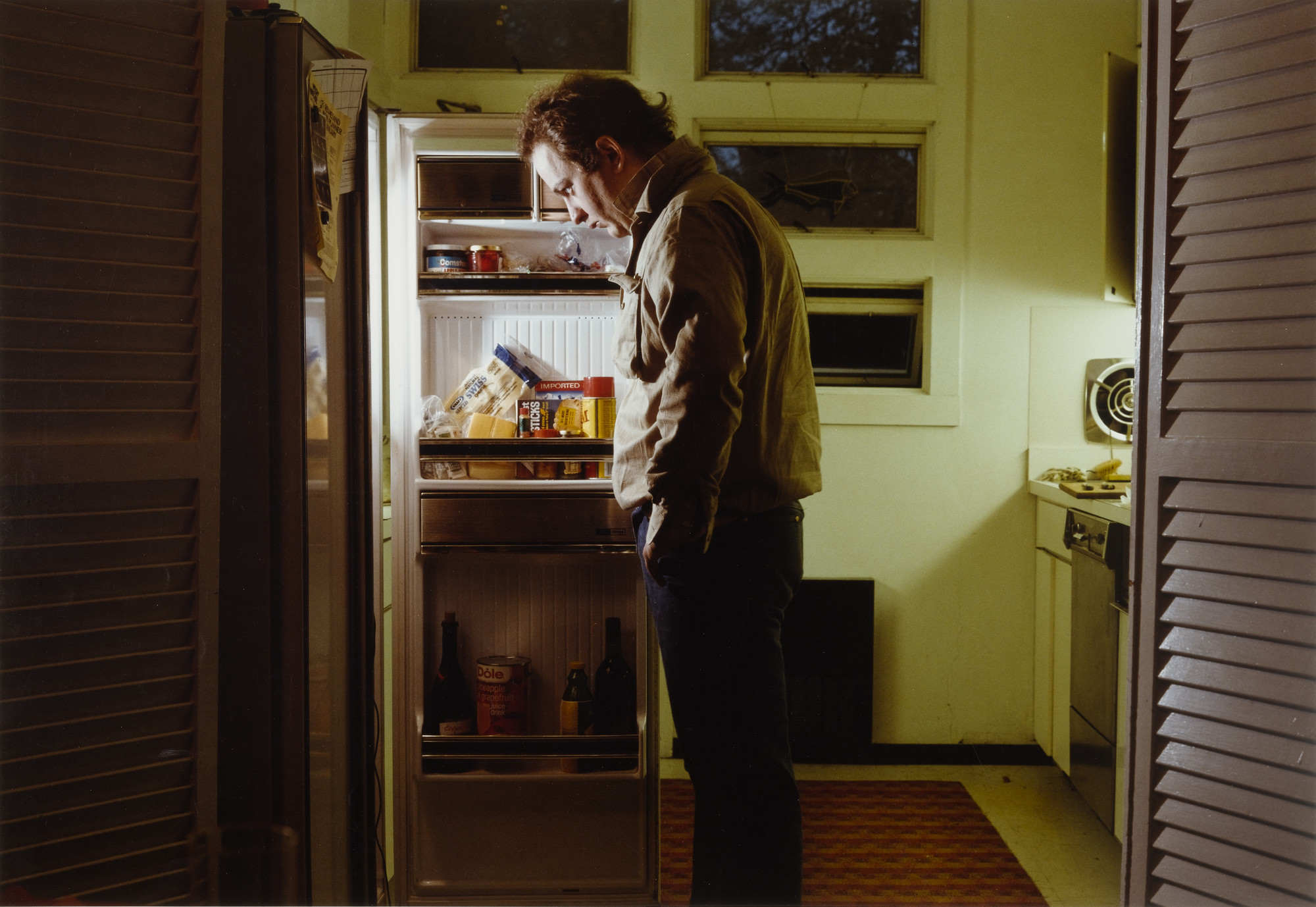
This photo presents Dicorcia's brother, 'Mario' staring into a refrigerator late at night. The light from the fridge presents the front of Mario is a harsh white light. The light almost appears as a stage light, as if it were presenting Mario in a dramatic moment, which creates irony because Mario is performing a very non-dramatical act. His posture is composed but he appears relaxed in this moment, as though the only truly important thing to him at this moment is deciding what to eat, which is very anti-climatic. But Dicorcia captures his brother so it appears as though this is a dramatic and impacting scene in Mario's life, when it truly isn't. The composition makes it appear as though Dicorcia is stalking Mario, hidden in the doorway to his kitchen, just watching him exist in his uneventful life; this will make the viewer feel intrusive and almost uncomfortable to be watching Mario. However, due to the meaningless meaning Dicorcia has created, the viewer will still be intrigued, attempting to find what is so meaningful in this photo, when really there is nothing. The light surrounding Mario is unnatural and dim, it is unable to brighten the whole of his surroundings, becoming insignificant, this could symbolise the motivation and hope in Mario's life. It is clear that Mario isn't a successful or very active person by this photo, the kitchen is rather small and minimalist with things, his hair is unkept and his surroundings appear unclean; these factors suggest an uneventful life for Mario.

Brent Booth; 21 years old; Des Moines, Iowa; $30
Image result for philip lorca dicorcia
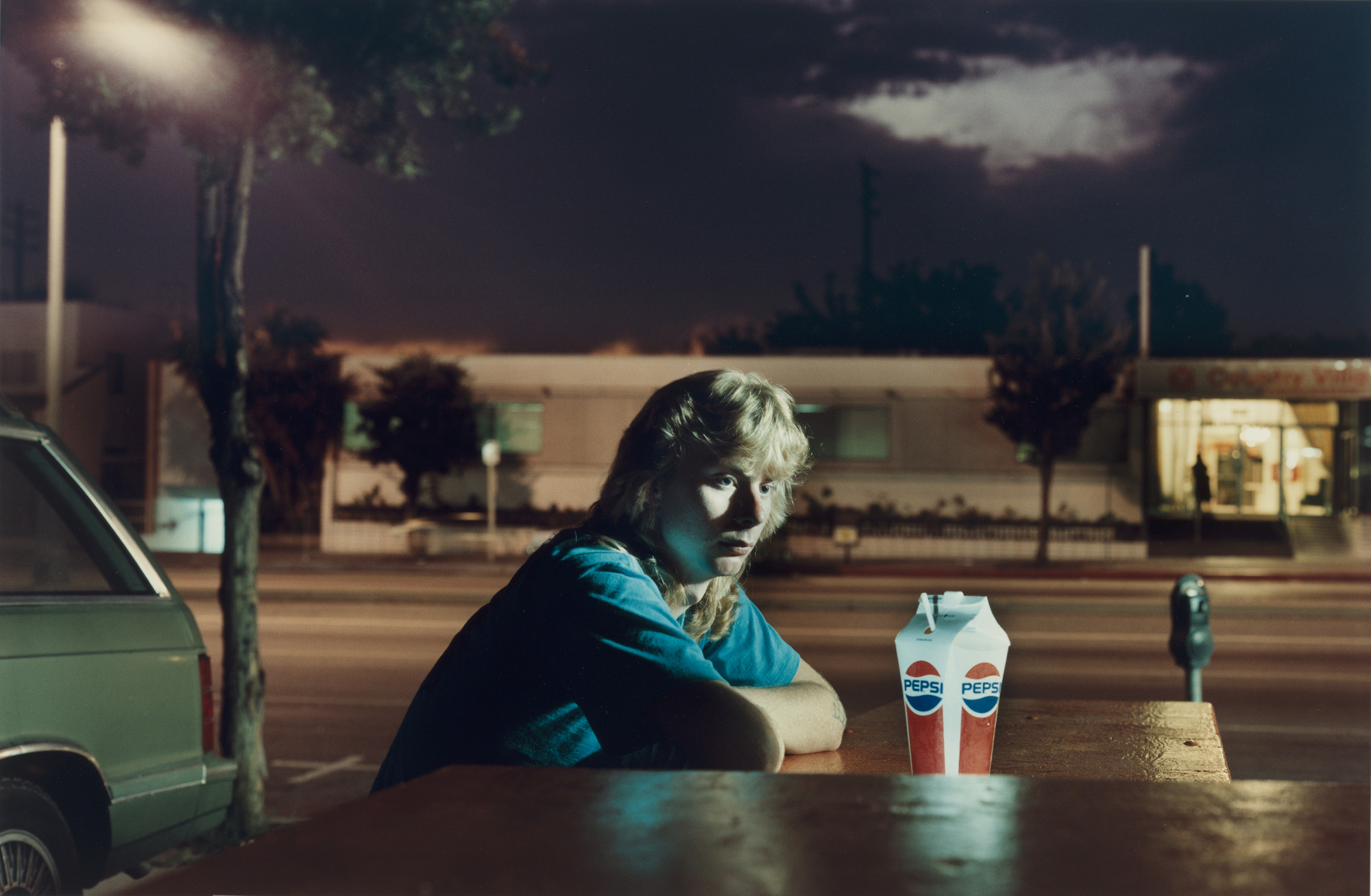
A selection of Dicorcia's photos captured male prostitutes from Saint Monica Boulevard, he would pay the men their usual price of service, and stage them in situations that accurately depict their lives. Here we see 'Brent' sat late at night by the road with a soda drink at a table. The street light highlights the details of Brent's face just from above. Brent appears to be lost in thought as he looks off to something in front of him that the viewer cannot see. Once again, the streetlight appears as a stage light to Brent, as if it shines onto his face so he can share his story to the viewer, share how he didn't make it in the states, and has resorted to selling himself to survive. Brent's unkept hair and simple clothing suggests he is still struggling with money, and by the price titled in his photo ($30), it would be clear as to why he is struggling. Having Brent sat late at night in the streets presents symbolism of him not having a home, showing him left alone in the cold night. Even the street he is captured at appears rugged and poor, a place he has no choice but to stay at because of the failure of his hopes and dreams. The streetlight makes Brent's face appear clinical and cold, leaving no warmth to the colouring of his skin, making him appear even more isolated in his life.

Marilyn; 28 Years Old; Las Vegas, Nevada; $30
Here Dicorcia captures 'Marilyn', also a male prostitute but who is dressed as a woman and named a woman's name. With him wearing a short black wig that appears cheap and tattered, and his face clearly powdered with also lipstick and eyeliner, with even a beauty spot placed on his cheek. It is unclear what he is wearing but it appears to be a simple red dress exposing his arms. Marilyn's face is presented by a bright streetlight just above him, which highlights his makeup and shoulders. The light presents his makeup harshly and makes the powder on his face have him appear very pale; almost a completely different skin tone to his arms. The red lipstick appears deep and feminises his features along with the beauty spot. Dicorcia used this lighting to highlight the fact that this man has had to resort to dressing as a woman to make money and survive, making many viewers sympathetic but also slightly disgusted by this unfortunate situation. The fact that we cannot know this man's real name leaves him as a mystery and almost as though he is not a real person, he is just an object for certain people to buy. There is a man sat behind Marilyn who appears possibly as a 'customer' or maybe a friend to Marilyn. If he is interpreted as a customer, this makes Marilyn appear vulnerable, he already appears frail with the way his arms are positioned almost to protect himself and his expression which feminises him, but adding the man behind him conveys how vulnerable he is, Marilyn actions now appear in command of this man. If the man is interpreted as a friend to Marilyn, this makes him appear less vulnerable, but does create more sympathy, it is almost as if Marilyn needs protection from customers and others so this friend is there to protect him, hence why he watches Marilyn in this photo because he is making sure he is okay.


Igor
Image result for philip lorca dicorcia
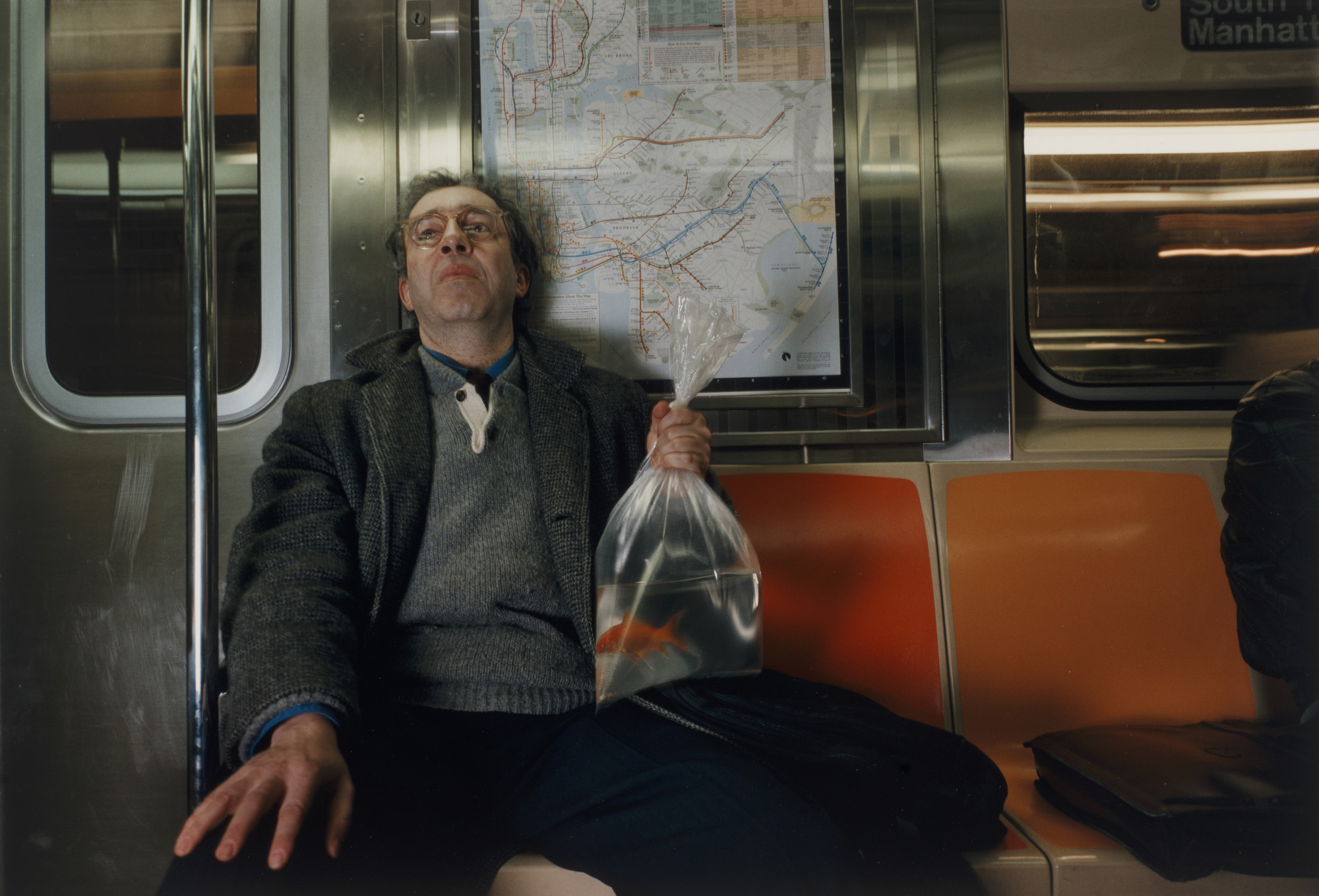
Here we are presented with 'Igor', sat on a train with a bag containing a goldfish in water. Igor is leant back on his seat and starring up to the lights of the train. The light from the train is reflected from the metal walls and plastic seats, so the area is well lit around Igor, presenting him in an even way. Igor appears to be an unusual and possibly foreign name, suggesting he is not from America, and came there in hopes of success, like the many others Dicorcia captures. This further suggests that Igor's expression is so vacant, because this is a foreign place to Igor, and he is lost with what to do in this country, or where to go. The fish in the bag suggests Igor was at a carnival and won the fish, but this is usually the reward for a child, this could symbolise that Igor is unable to achieve the things he truly desires and is left with minuscule rewards that he does not strive for. His expression appears forlorn and empty, as though he is unsatisfied with life, and this train ride feels meaningless to him, and the fish feels meaningless to him. All these things surrounding him and he appears unsatisfied with life.

Overall...

I feel Dicorcia's work is an excellent depiction of lives that are broken and desperate in a dramatical and beautiful way. Using artificial light from streetlights, fridges, trains, etc, to capture someone in a theatrical atmosphere, as if Dicorcia opened the stage for these people to tell their story in a photo. I found no specific camera techniques in Dicorcia's work but a method he uses is highlighting the subject's face with the artificial lights to create an impact. I will use this when recreating his work for my inspiration.

Author Unknown, "Philip-Lorca diCorcia
American, born 1951", [https://www.moma.org/artists/7027?locale=en&page=&direction=], (accessed: 11/02/2020)

After Recreation...

After research into Dicorcia's work, I discovered there to be no specific techniques in the editing or camera processes but a common composition where the light is used to highlight the subject and create a story line to the subject by their environments. I only took the feature of highlighting the subject in my photos. My photos are more eerie compared to Dicorcia's but the subject (me) is still highlighted. Dicorcia used various artificial lights such as street lights, lights from trains, fridges, etc, for my photos I used a snoot light to direct the light onto my face and neck from the left side of me. I did vary the exposure settings at points to create a different intensity of light, Dicorcia tended to use a sharp light on the subject, but this was blended with the dark and warm surroundings. My intentions were not to perfectly recreate Dicorcia's work, but to take the dramatic atmosphere that he created, which I feel I was successful in doing.

Friday, 6 March 2020

WR2

Plans for Shoot

For this shoot, I will be researching into the photographer Bettina von Zwehl, who was recommended in the exam paper, I will then be recreating Zwehl's work personally, and see where this will influence my future work.

Research
Bettina von Zwehl
Bettina von Zwehl is a German photographer who lives and works in London. She is known for her "subtle and unnerving" portrait photography. Many of her portraits are either of children in formal presentations and harsh lighting, or of adults in unflattering and odd positioning and lighting. I did further analysis on Zwehl's work in the blog post "Photographer Research - Bettina von Zwehl". After research into her work, it was clear that Zwehl used harsh studio lighting and most likely a lower shutter speed to capture the slight movement captured in the models.

Image bank
These are a few photos from Zwehl's portfolio 'Alina'.

Contact sheet
These are all the photos I took for this shoot.


Best Photos
These are the best-selected photos from this shoot.


Photos that require improvement
These are a few of the photos that required improvement in my shoot, the issues with these photos was due to shutter speed settings. In Zwehl's work it appeared as though she used a slightly longer shutter speed to capture a slight motion in the photo. So, during my shoot I experimented with different shutter speeds to try and recreate this. In the brighter photos the shutter speed was roughly 1/60-80sec, however in these darker photos the shutter speed was roughly 1/4-2secs, also increasing the aperture to F11. This unfortunately removed the intensity of light in the photo and created a slight yellowish haze in the photos. This shutter speed was for too long and captured too much movement, leaving an unsettling yellow blur to the photos which does not represent Zwehl's work accurately. Once realising this I changed the shutter speed back to a faster setting to ensure the light intensity was still there and and blur was at minimal intensity.

AO3: Record ideas, observations and insights relevant to intentions, reflecting critically on work and progress.

My Ideas

My intention for this shoot was to research into the second recommended photographer Bettina von Zwehl and use this research to recreate her work and further influence my topic of artificial lighting. From my research I discovered that Zwehl used intense studio lighting settings to create a harsh and sterile light onto the models, she also candidly captured the models using a long shutter speed to capture the slight impression of movement, this helped me with recreating her work. When creating my own shoot, I was unable to recreate the exact setup to Zwehl's, so this effected the recreation accuracy. I varied my shutter speeds in my shoot to see which would best recreate the minimal blur that Zwehl creates. I do not feel I was as successful as I intended to be with this shoot, as my photos compared to Zwehl's lack something that Zwehl's has and it appears vital. 

Reference to best photos

I selected this photo because of the personal atmosphere it creates with the viewer. This photo may not be candid like Zwehl's but this still creates a perplexing and intense atmosphere to the photo. Due to me looking directly into the camera, with a rather vacant expression to my face, it makes the viewer feel as though they have intruded my personal space and I have no confronted them, creating this awkward tension between me and the viewer. My surroundings being completely white and empty makes it appear as though I am in my own world different from the viewer's, and I am curious of it in this photo, hence why I am looking out to the viewer.

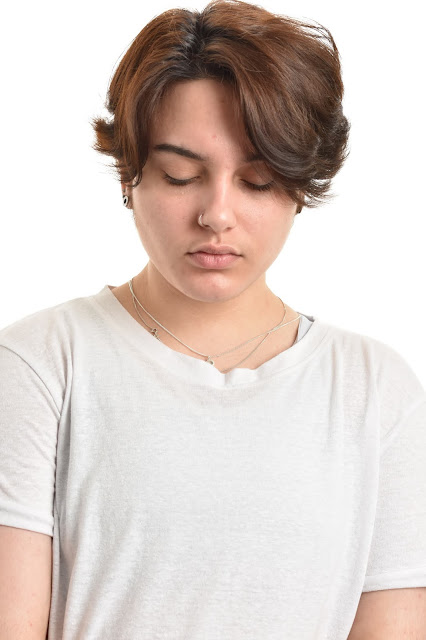
I selected this photo because I feel it is an accurate recreation of Zwehl's work. My body posture appears stiff and rigid, as though something is making me uncomfortable while this photo is being taken. Due to my face looking down and appearing deep in thought but slightly uncomfortable could suggest that my discomfort is coming from something I am thinking about, a bad memory perhaps. My entire presentation conveys a hostility, as if the viewer shouldn't be viewing this photo and is intruding on something serious and personal. The completely clear white background could make it appear as though I am so deep in thought that the world around me has disappeared, and I have been left to my own mind.

I selected this photo because of the curious atmosphere it creates. My body expression appears slightly more relaxed in this photo, but my facial expression coveys curiosity. The direction of my eyes suggest I am possibly enclosed in my thoughts, but it could also suggest there is something I am seeing that the viewer cannot see, this can create curiosity for the viewer. My facial expression could create an unsettling feeling for the viewer because they are unable to understand what I am feeling or doing.

AO2: Explore and select appropriate resources, media, materials, techniques and processes, reviewing and refining ideas as work develops.

Shoot Process/Use of Camera

For this shoot, I used the college studio and studio equipment to create my photos. Using a white backdrop behind me and pointing two dish lights to it to make sure during photos the background is a strong clear white. Then using a softbox to the left of me to flash a harsh white light, and a reflector to the right of me to then bounce that softbox light back onto the right side of me also. Using a clicker connected to the camera to make sure all equipment flashes at the appropriate time when the photo is taken, and using self-timer and a tripod to take the photos of myself. I used my Nikon D3400 camera and the settings were shutter speed varying from 1/4-1/80, and aperture dominantly set at F8, and exposure set to ISO200. I was unable to completely recreate Zwehl's work and hadn't involved a table or sitting in my shoot, so instead I would pose in front of the camera and attempt to move slightly just before the camera took a picture so I could recreate that slight impression of motion in Zwehl's photos and recreate the impression of me being candid during the photos being taken.


Experimenting

For the photos, I feel the actual subject (me) was over exposed, but to change this with the camera involved changing the exposure to the background also. So, using 'camera raw', I was able to slightly alter the exposure and saturation to photos and make them appear more defined on the subject (me).
Overall, I feel this slight editing helped the photos appear sharper and give more of an impact, so this edit was useful.

AO1: Develop ideas through sustained and focused investigations informed by contextual and other sources, demonstrating analytical and critical understanding.

Through my research, I have learned new studio techniques in creating a surreal and sterile lighting setting using studio equipment. I was also able to practice and almost perfect my technique in shutter speed to create a minimal motion blur in my photos. Zwehl helped me to better learn studio techniques and also understand better symbolism and connotations for possible photos.

AO4: Present a personal and meaningful response that realises intentions and, where appropriate, makes connections between visual and other elements. 


Progression

Overall, I feel Zwehl's work is representing a distorted empowerment to women by presenting their vulnerability in a harsh and strident way. She presents them in vulnerable compositions and uses bold lighting to make them appear helpless and in a clinical setting. I feel though I was not the most successful in recreating Zwehl's work, this was due to being unable to perfectly recreate the composition of her photos and unable to find a specific camera setting that recreated Zwehl's settings. The composition of these photos are impacting to the viewer, but I feel it does not meet the theme I wish to create in my personal work. So, moving forward, I would still like to further experiment with portraiture for artificial lighting, so in my next shoot I will look into portraiture incorporating artificial light in a more subtle and emotional manner.